The Leave a Mark OKR Manual, Part 1, Article 3
Here is the fastest way to kill an OKR programme before it starts: put a number next to everything your team already does, call the whole list "OKRs", and feel productive.
We see it constantly. A company decides to "do OKRs", opens a spreadsheet, and fills it with the metrics they were already tracking. Uptime. Monthly revenue. Ticket response time. Every one gets a target, and the whole dashboard gets rebranded. Nothing about how the team works actually changes. They've confused two different tools that happen to both involve numbers, and the confusion quietly guarantees the OKRs will do nothing.
So before the manual goes any further, let's settle the most common question in this whole topic: what's the difference between an OKR and a KPI, and which one do you actually need?
The short version
A KPI measures the health of something you already do. A Key Result measures a change you're trying to make.
That's the whole distinction, and almost everything else follows from it. KPIs watch the machine you've already built. OKRs are how you build something new, or fix something broken, on purpose, this cycle.
Both are useful. Most companies need both. The mistake is treating them as the same instrument, or picking one when the situation called for the other.
KPIs: the vital signs of business-as-usual
A Key Performance Indicator is a metric you keep an eye on because it tells you whether the business is running properly. Uptime. Gross margin. Customer satisfaction. Cash in the bank. On-time delivery.
Notice what these have in common. They are ongoing. There's no finish line. You don't "complete" uptime; you keep it healthy, quarter after quarter, forever. A KPI has a threshold, a level you want to stay above or below, and your job is to hold it there while you do everything else.
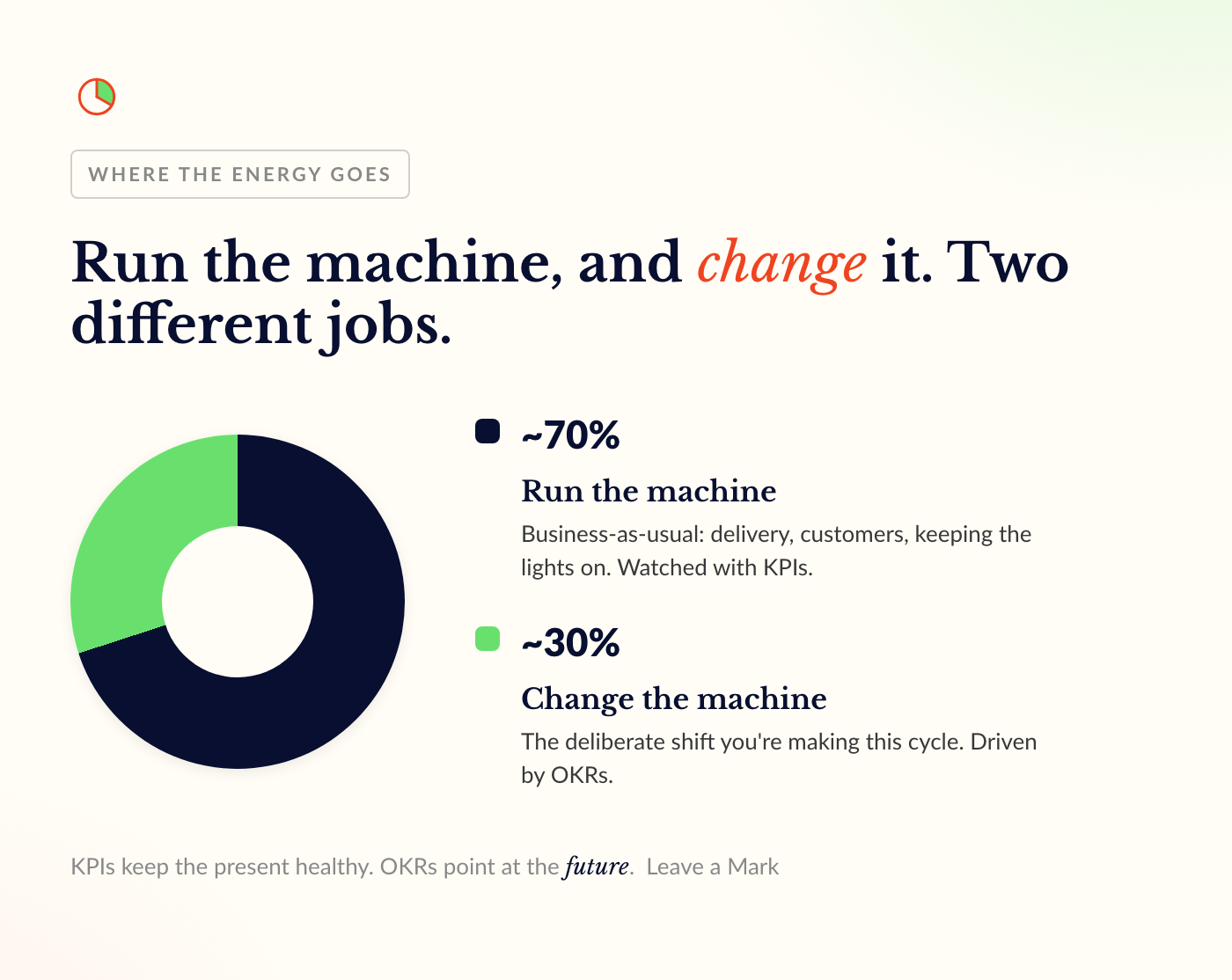
This is the running of the machine. It's most of the work in most companies, and it should be. Call it 70% of the organisation's energy: delivering the service, serving the customers, keeping the lights on. KPIs are how you know that part is working. They're vital signs. You check them, and if one drifts, you react.
What KPIs do not do is create change. Holding a number steady is maintenance, not progress. And that's completely fine, until you mistake it for progress.
OKRs: the change you're choosing to make
A Key Result lives in a different job entirely. It measures a deliberate change, from a starting value to a target value, inside a defined cycle.
The change is the whole point. You're not holding a number steady; you're moving it, on purpose, because you've decided that this shift matters more than the twenty other things you could improve. That's the other slice of the organisation's energy, the roughly 30% you point at the future instead of the present.
An OKR has a start and a target (X to Y) and a deadline. When the cycle ends, you either moved the number or you didn't. Unlike a KPI, it's supposed to end. Next cycle, the change you care about might be somewhere else entirely.
This is why an OKR without a number isn't an OKR, and why a number that never moves isn't one either. If the target is "keep it where it is", you've written a KPI and put an OKR costume on it.
The same metric can be either. That's the trap.
Here's the part that trips everyone up: the exact same metric can be a KPI in one quarter and a Key Result in the next. What changes is the job you're asking it to do.
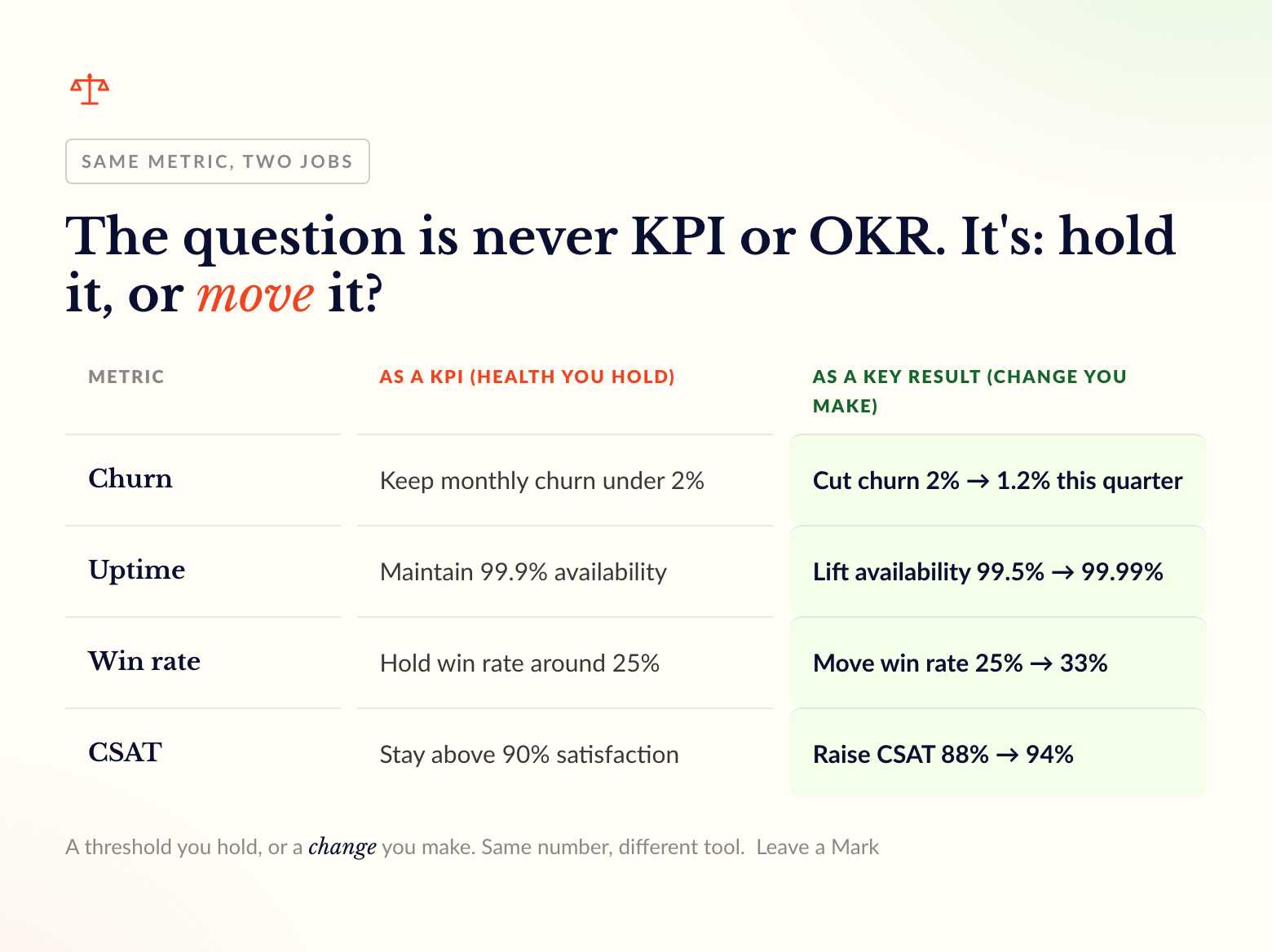
Left column: you're keeping a healthy number healthy. Right column: you've decided this number is the thing you're going to change, and you're pointing real focus and initiatives at it for one cycle. Same metric, completely different tool.
Get this backwards and you get the two classic failures. You either turn stable, healthy metrics into "OKRs" (so your OKRs are just a to-do list of maintenance), or you bury a genuine, hard-won change inside a KPI dashboard where nobody rallies around it.
The test: would the business break next month?
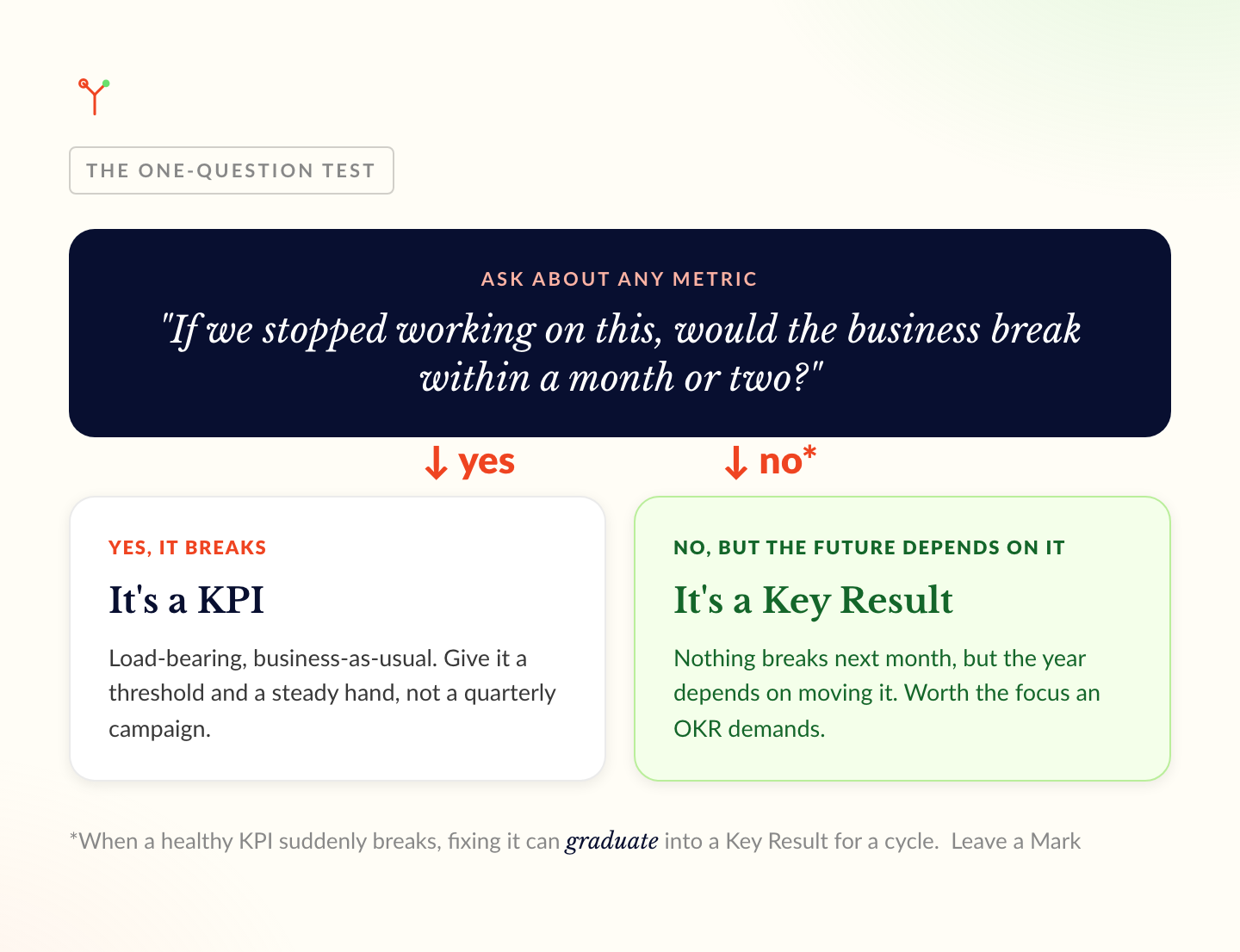
When you're not sure whether something belongs in your KPIs or your OKRs, ask one question:
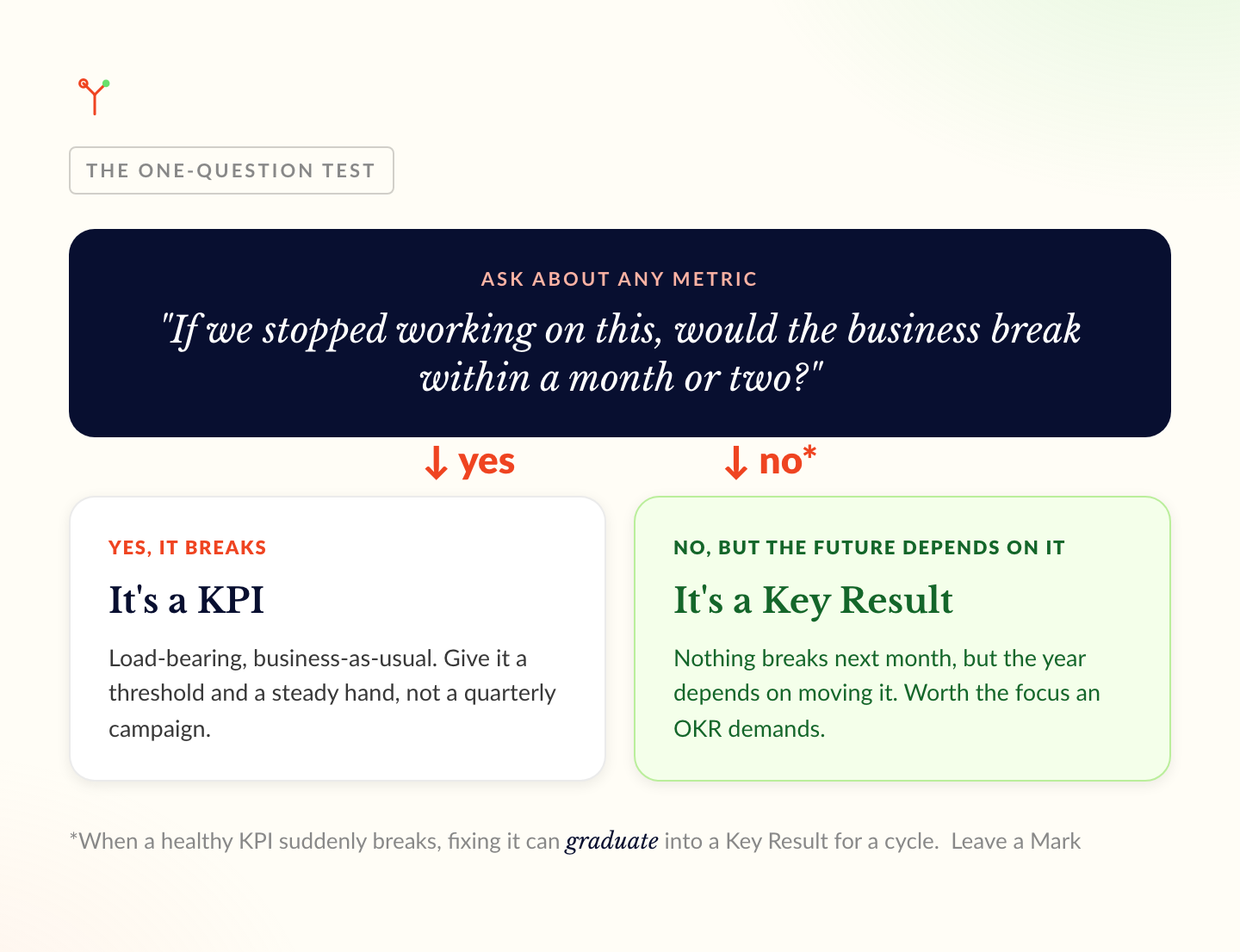
If we stopped actively working on this, would the business break within a month or two?
If yes, it's a KPI. It's load-bearing, it's business-as-usual, and it needs a threshold and a steady hand, not a quarterly campaign. Stop serving customers and you're done; that's a vital sign, not a change initiative.
If no, but the future of the company depends on moving it, you're in OKR territory. Nothing breaks next month if you don't improve activation, or enter that new segment, or fix the onboarding that's quietly capping your growth. But the year depends on it. That's a change worth the focus an OKR demands.
Load-bearing and healthy goes in the KPI column. Not-yet-urgent but future-defining goes in the OKR column. When a KPI you'd normally just hold suddenly breaks, and fixing it becomes the most important change you can make, it graduates: for a cycle or two it becomes a Key Result, until it's healthy again and drops back to being a vital sign you simply watch.
You might only need KPIs. That's an honest answer.
Here's something most OKR content will never tell you: plenty of companies don't need OKRs at all.
If the business is running well, the machine is healthy, and there's no big change you're trying to force this year, then a good set of KPIs and clear targets is enough. Really. Watching your vital signs and hitting your targets is a perfectly good way to run a stable company. Bolting on an OKR programme because it's fashionable just adds ceremony to a business that didn't need it.
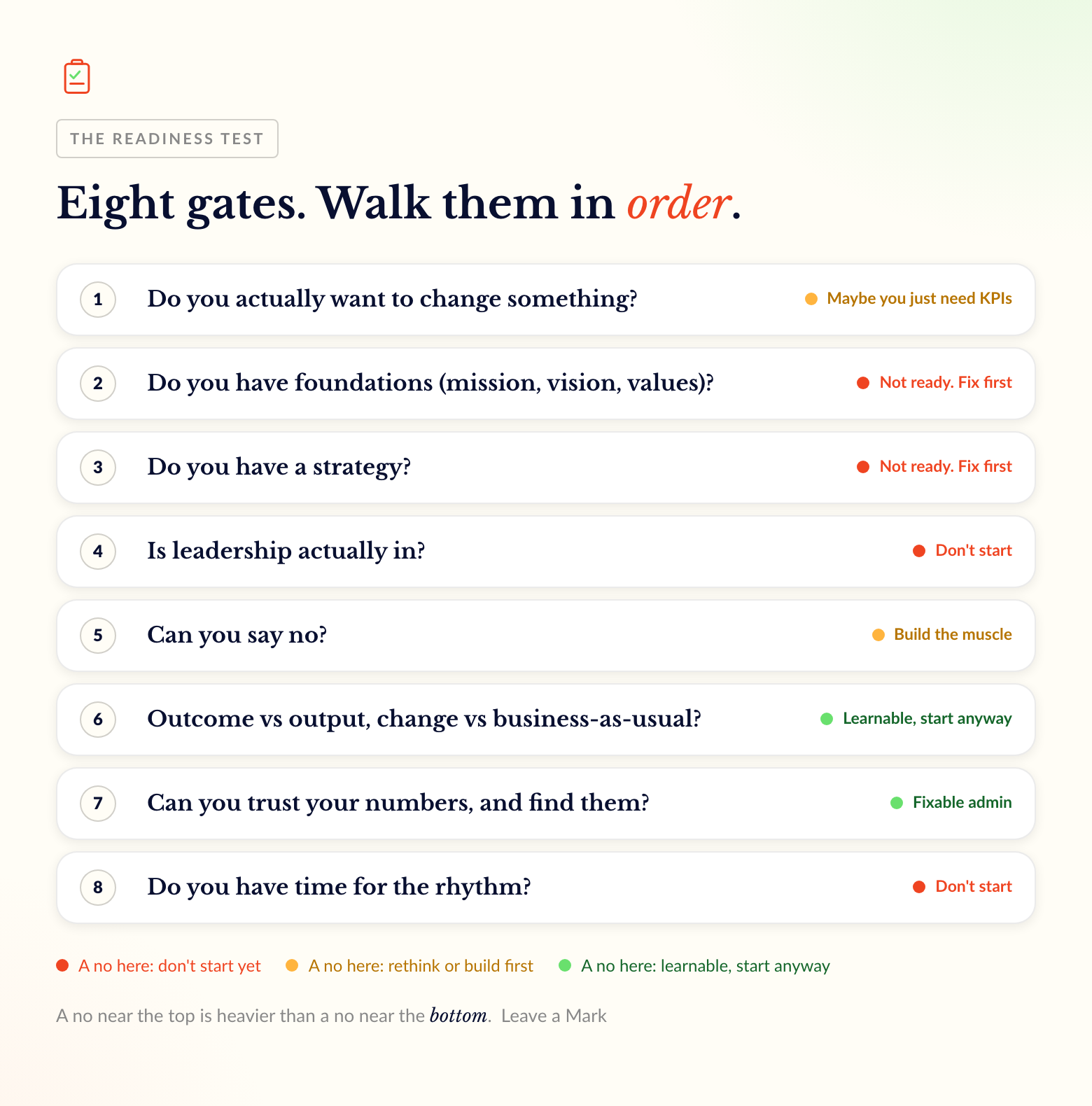
OKRs earn their cost only when you have a change worth the focus, and the appetite to say no to everything else to get it. No change on the horizon, no OKRs required. We'll help you figure out exactly that in the next article, the readiness test.
The trap: rebranding your dashboard
The single most common way this goes wrong is the one we opened with. A team takes its existing KPI dashboard, renames it "OKRs", and declares the project done.
New vocabulary, zero change. The numbers are the same, the work is the same, the Friday-afternoon update ritual is the same, and the leadership team gets to say they "do OKRs" now. It is pure theatre, and it's worse than doing nothing, because it burns the credibility of the word for the next time you actually need it.
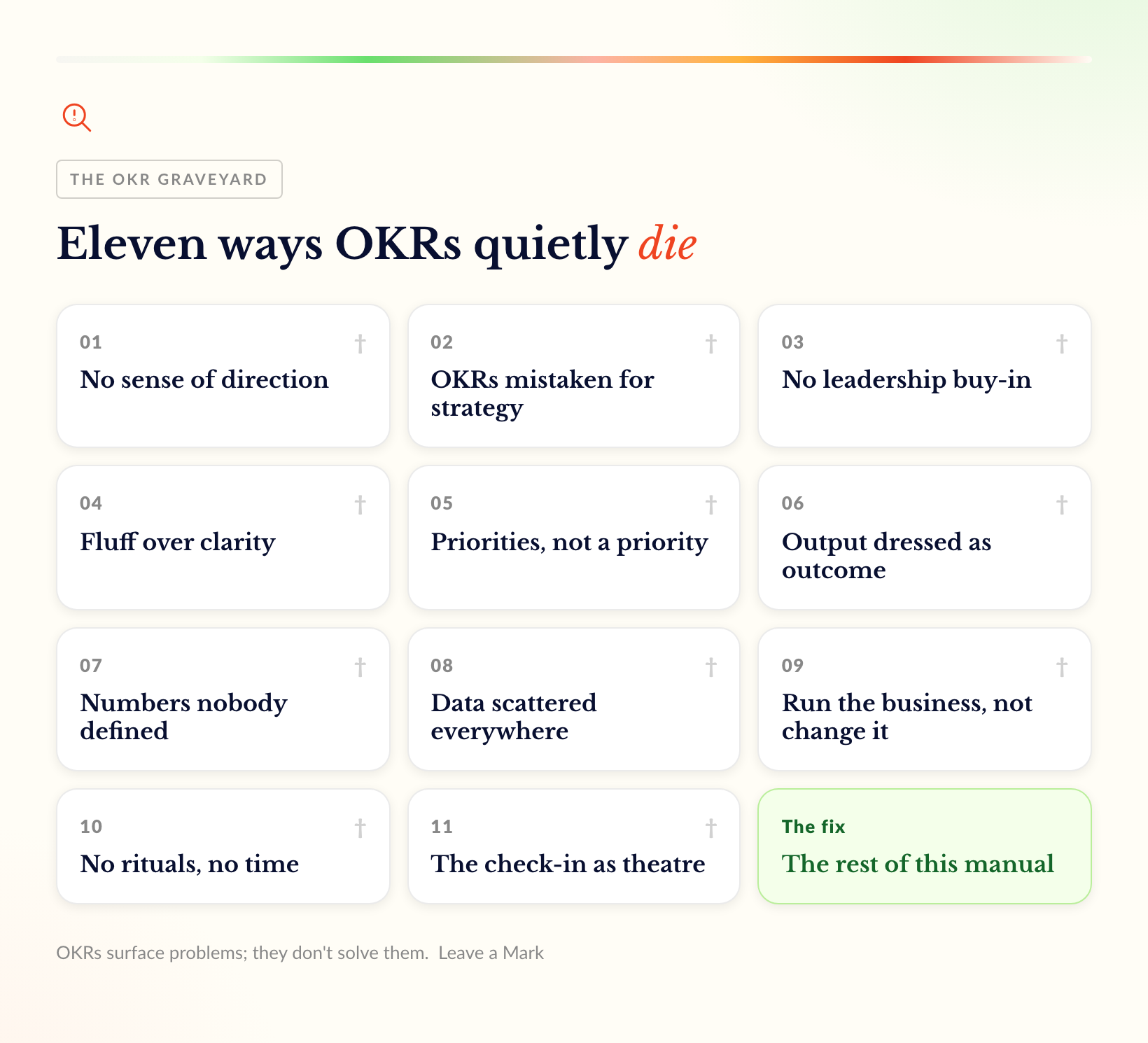
If your OKRs are indistinguishable from the dashboard you had last year, they aren't OKRs. They're the same behavior wearing a new label. And OKRs surface problems; they don't solve them. The first problem a real OKR surfaces is often this one: that the company hasn't actually decided to change anything.
The takeaway
KPIs measure the health of what you already do; they have thresholds, and they never end. Key Results measure a change you've chosen to make; they go from X to Y, and they do end. Most companies need both: KPIs to run the machine, OKRs to change it. The same metric can play either role, so the question is never "KPI or OKR?" in the abstract, it's "am I holding this number or moving it?"
Next: the readiness test. Before you write a single Objective, we'll find out honestly whether your company is ready for OKRs, or whether good KPIs are all you need right now.
Leave a Mark helps leadership teams turn strategic chaos into clarity and execution, working side by side until clear strategy, focused priorities, and a new operating rhythm hold on their own. Strategy that becomes behavior.