The Leave a Mark OKR Manual, Part 1, Article 4
Most OKR programs fail before anyone writes a single Objective.
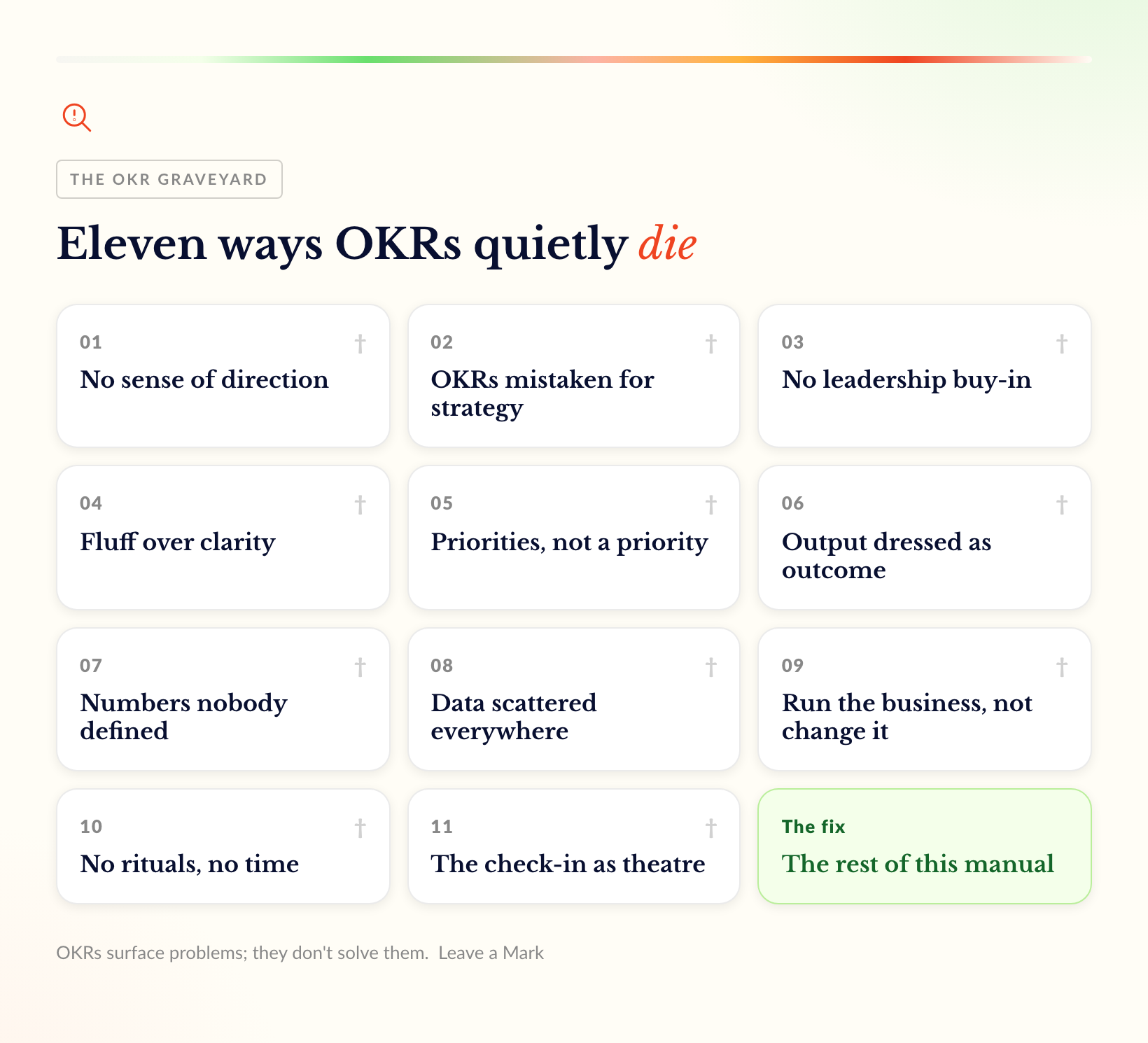
By now you know the building blocks (Article 1), the eleven ways they die (Article 2), and how they differ from KPIs (Article 3). Here's the uncomfortable follow-up: knowing all of that still doesn't mean your company is ready to run them. Readiness is its own question, and almost nobody asks it. They just open a template and start typing.
So before you do that, take the test. It's a short one. It won't tell you whether OKRs are good. It'll tell you whether they're good for you, right now, and if not, exactly what to fix first.
One rule before you start: answer honestly. A "no" here is not a failing grade. It's a map. Every no you find in this article is a problem you'd otherwise discover three months into a struggling OKR cycle, at far greater cost. Finding it now is a gift.
How to take it
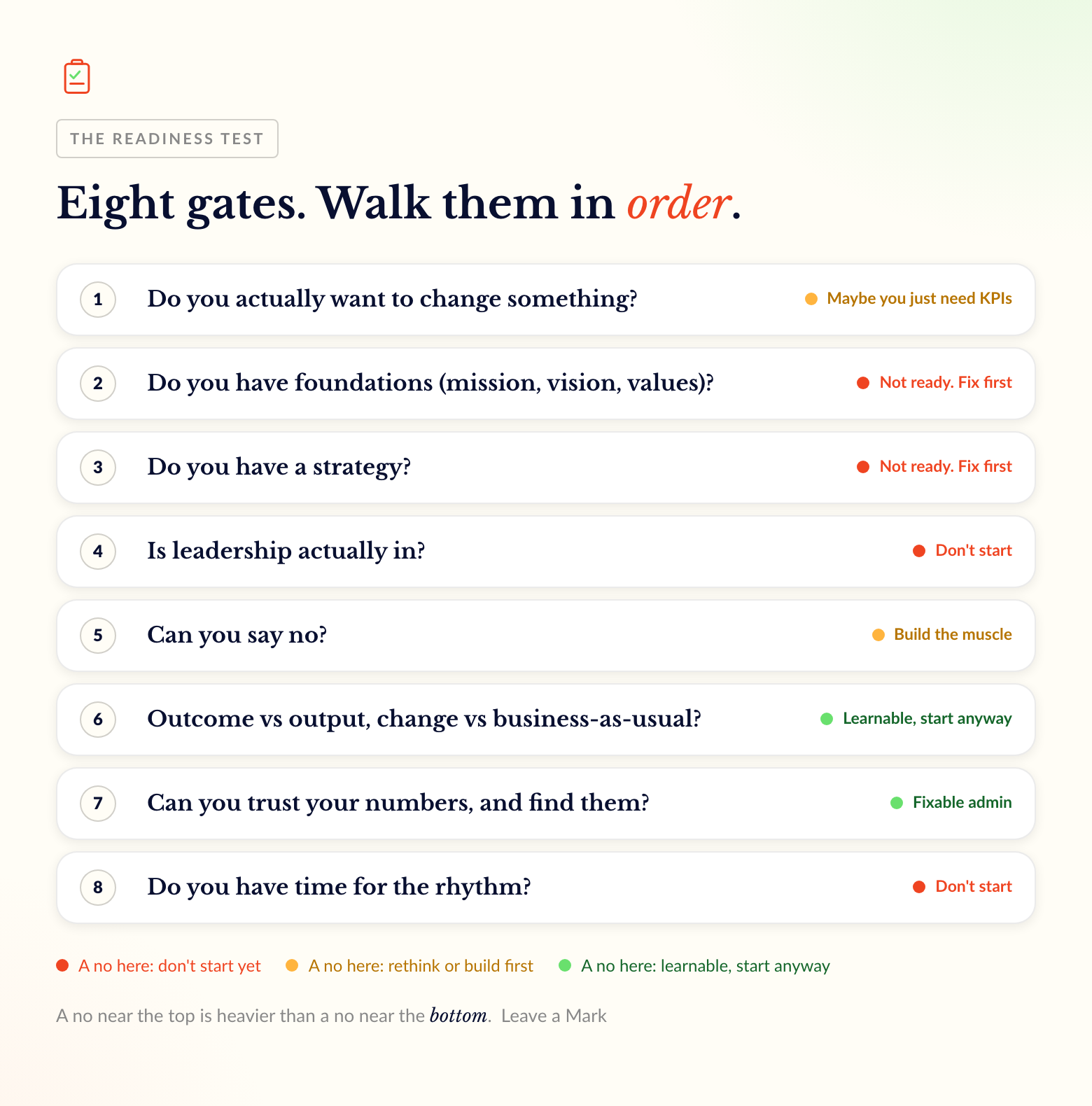
Below are the gates. Walk them in order. At each one, give yourself an honest yes or no, and keep count of the nos and where they land. Where they cluster matters more than how many there are. A no near the top (foundations, strategy) is heavier than a no near the bottom. You can learn to write a good Key Result in an afternoon; you cannot conjure a strategy in one.
Gate 1: Do you actually want to change something?
OKRs are a tool for change, not for running the machine you already have. So the first question isn't about readiness at all, it's about intent. Is there a real change you're trying to make this year, something the business isn't doing today that it needs to?
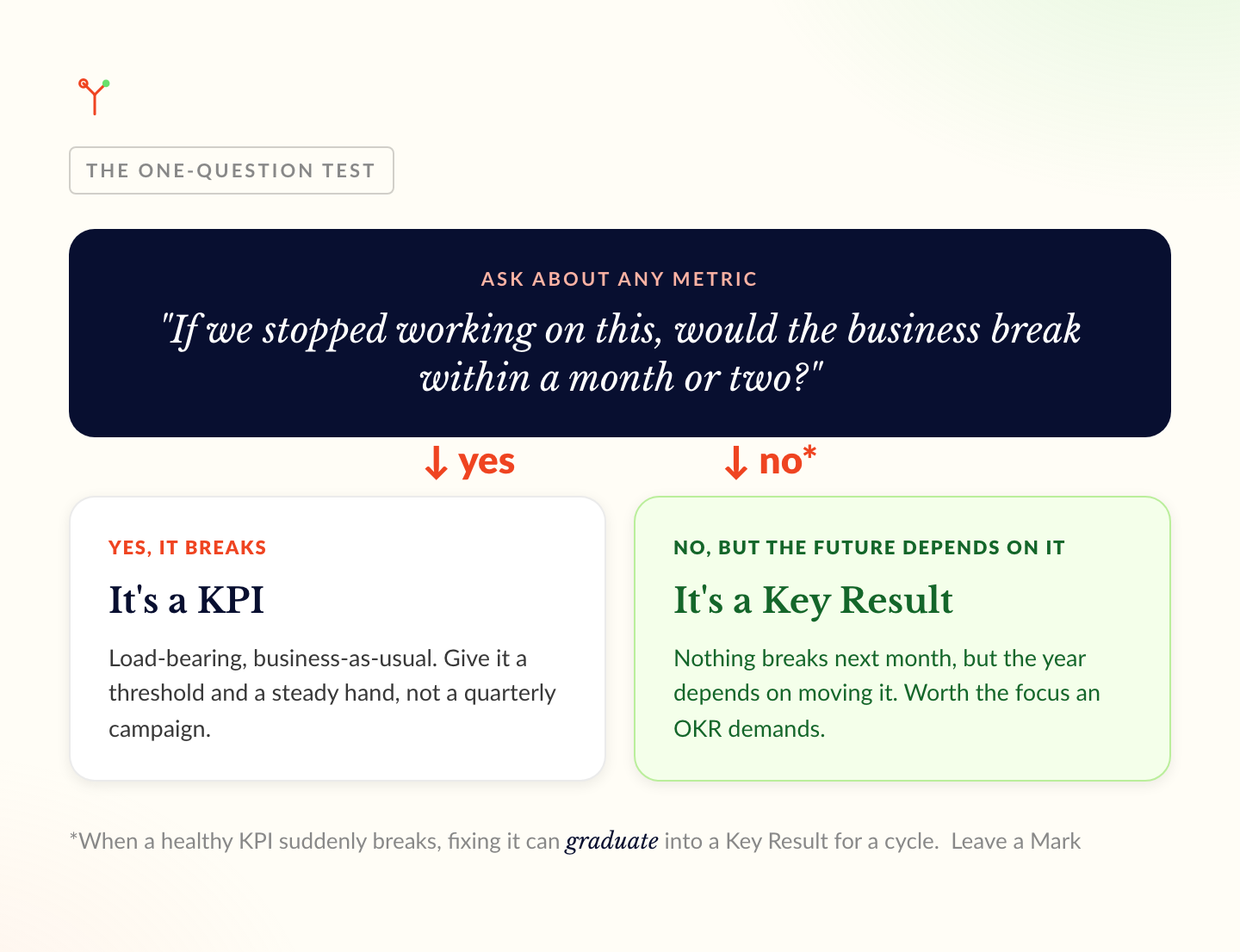
If yes, keep going. If no, if the company is stable and you mostly need to keep doing what works, stop here. You don't need OKRs. You need good KPIs and clear targets (see OKRs vs KPIs: You Probably Need Both - Article 3). That's not a lesser answer. It's the right tool for a business that doesn't need to change direction.
Gate 2: Do you have foundations?
Mission, vision, values. The boring basics. Does your team share a sense of why the company exists and where it's heading?
If no, fix this first. OKRs don't create direction; they assume it. Point a team at OKRs without foundations and each person invents their own, pulling in different directions with great energy. Foundations sit at the top of the pyramid from Article 1, and everything below leans on them.
Gate 3: Do you have a strategy?
Not a strategic plan. A strategy: a clear choice about where you'll play and how you'll win. Can you say, in a sentence or two, what you're betting on and what you're deliberately not doing?
If no, this is the most expensive no on the list, and the most common. OKRs execute a strategy; they can't replace one. Skip this gate and your OKRs become a tidy list of goals that quietly work against each other. Build at least a rough strategy before you go further.
Book a call with us to guide you through that
Gate 4: Is leadership actually in?
Not politely supportive. In. Will the CEO show up to the check-ins, make the hard calls in public, and let their own numbers go red in front of the team?
If no, don't start. This is the reason from Article 2 that kills the most programs. OKRs demand visible ownership from the top; without it, everyone below quietly opts out and you get theater. At minimum, you need the CEO genuinely committed.
Gate 5: Can you say no?
OKRs only work if you focus, and focus is subtraction. Are you and your leadership willing to pick a small number of priorities and consciously drop the rest, at least for a cycle?
If no, you'll drift into the everything-is-a-priority trap and end up with a wall of goals nobody can act on. Focus is a muscle. If it's weak, start by forcing yourselves to name the three things that matter most this quarter, and practice letting the rest wait.
Gate 6: Do you know outcome from output, and change from business-as-usual?
Can your team tell the difference between "ship the feature" and "move the number the feature was meant to move"? And between the metrics that keep the lights on (KPIs) and the change you're chasing (OKRs)?
If no, this one is learnable, and fast. Check out content on what to do here. But learn it before you write, because getting it wrong produces OKRs that are really just to-do lists with numbers stapled on.
Gate 7: Can you trust your numbers, and find them?
Two parts. First: when a metric has a target, does everyone agree how it's calculated? Second: do you know where your numbers actually live, so you can update them before a check-in instead of hunting for them during one?
If no on either, this is fixable admin, not a deep flaw, but it's the kind of thing that quietly sinks check-ins. Agree your definitions and decide where each number lives before your first cycle, not during it.
Gate 8: Do you have time for the rhythm?
OKRs cost time: a few hours to set a cycle, then a short weekly check-in, a summary, a retro. Roughly one to two hours a week across the quarter. Can your leadership genuinely commit that, every week, not just in the enthusiastic first two weeks?
If no, don't start. OKRs without a rhythm are just a document you wrote once and abandoned. If you can't protect the cadence, you're better off waiting until you can.
Reading your score
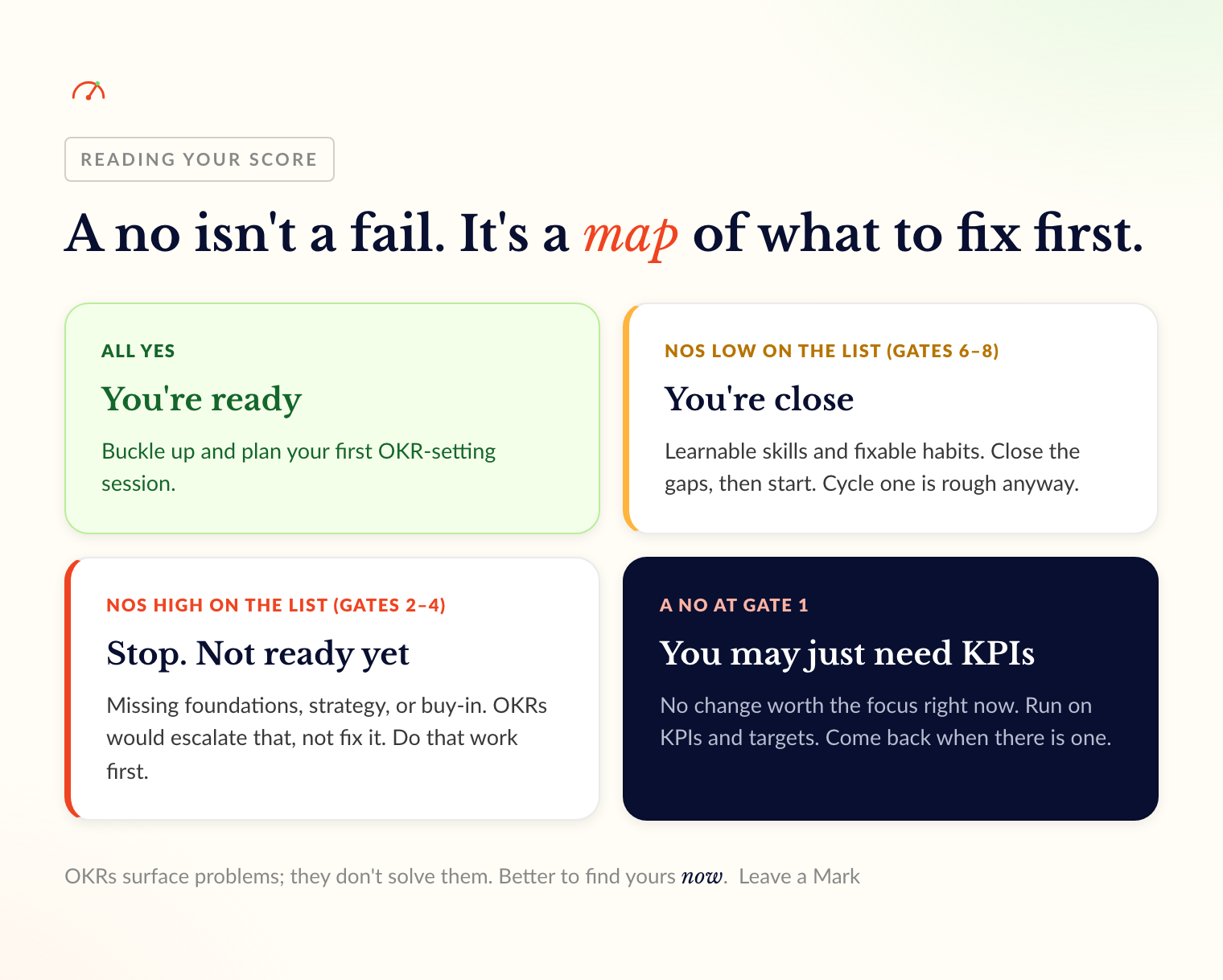
Now look at where your nos landed.
All yes. You're ready. Buckle up and plan your first OKR-setting session. The next article shows you how to actually write them.
A few nos, low on the list (Gates 6 to 8). You're close. These are learnable skills and fixable habits, not missing foundations. Close the gaps, then start. Don't let "we're not perfect yet" become an excuse to wait forever. Your first cycle will be rough anyway, and that's fine.
Nos high on the list (Gates 2 to 4). Stop. You're not ready, and starting now would only prove it expensively. No foundations, no strategy, or no leadership buy-in means OKRs will escalate the problem, not fix it. Do that work first. It's harder and less fashionable than "doing OKRs", and it's the actual job.
A no at Gate 1. You may not need OKRs at all right now, and that's a perfectly good place to be. Run on KPIs and targets, keep the machine healthy, and come back when you have a real change worth the focus.
The honest part
Most OKR content is selling you OKRs, so it will never tell you not to do them. We will. If you're not ready, the bravest and cheapest thing you can do is wait, and fix the layer underneath first. OKRs surface problems; they don't solve them, and a program launched on missing foundations just surfaces those problems louder, in public, in front of a team that has now lost faith in the tool.
But if you passed the gates, or you know exactly which ones to close first, you're in a rare position. You're starting OKRs with your eyes open, and that alone puts you ahead of most of the companies that fail.
Next: how to write OKRs that actually work. Objectives that mean something, Key Results that move, and the difference between the two that most teams never quite get right.
Leave a Mark helps leadership teams turn strategic chaos into clarity and execution, working side by side until clear strategy, focused priorities, and a new operating rhythm hold on their own. Strategy that becomes behavior.